
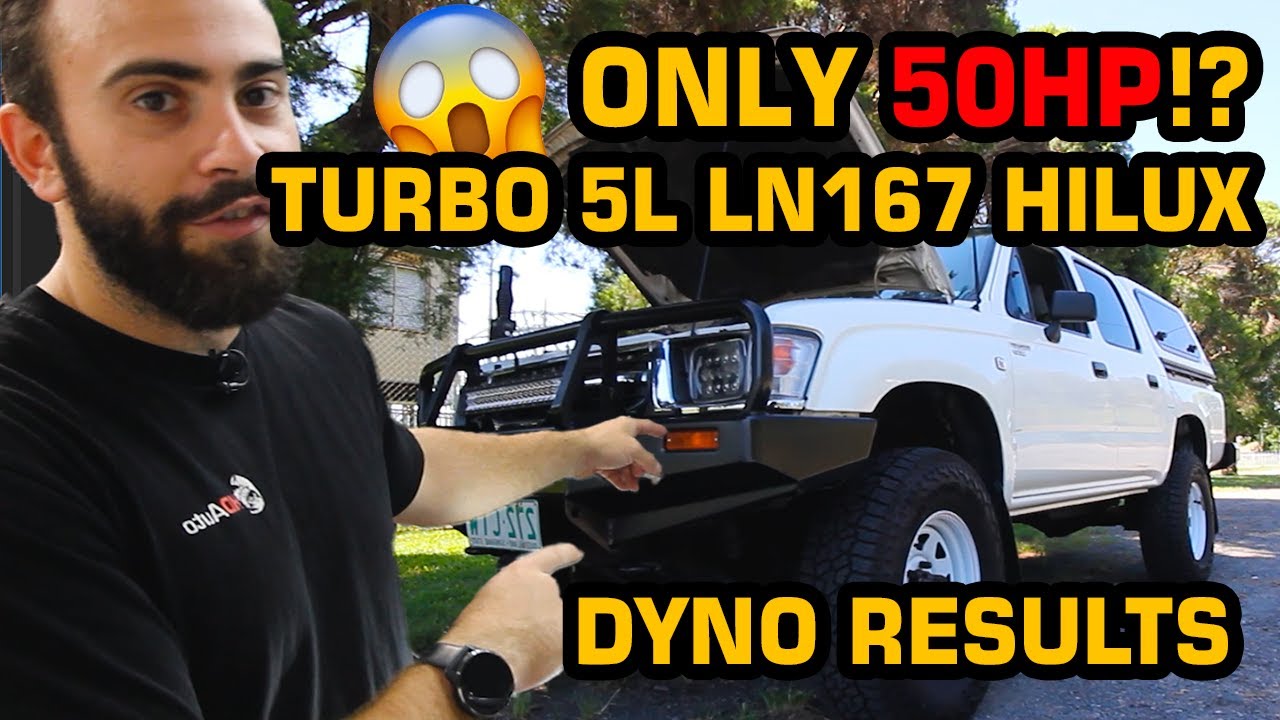
You might be surprised to hear this…
But the Toyota Hilux LN167 and similar models, they’re only making about 50HP at the wheels.
It almost seems unbelievable.
So, if you don’t believe me, check out our video here.
But if you came here to actually find out HOW to make more power out of your 5L 3.0D powered Toyota Hilux, then feel free to continue reading.
Ok, so, 50hp. What next?
These vehicles were released in 1998, and they were a reiteration of what the LN106 solid axle Toyota Hilux fitted with the 3L 2.8D once was. The 5L 3.0D engine, is virtually indistinguishable from the earlier 3L 2.8D diesel engine sharing pretty much all the same components.
In the last 30 years, people have tried everything to get more power of these things.
Starting with extractors, then a full 2.5″ exhaust system to follow, and one thing remained consistent. It was never enough.
It was not money well spent.
It was high cost, for low gain, or no gain, really.
That’s probably not what you wanted to hear…
And, I’m sorry.
But, it’s not the end.
It really only leaves us with one option.
Turbocharging Your Toyota Hilux
Turbocharging diesel engines to extract more power has been the go to option since turbochargers became a thing.
And when it comes to the Toyota Hilux LN167, things are no different.
How does it work? Because, Toyota didn’t make this engine to handle boost, so, won’t it blow up?
No, Toyota never produced the 5L engine with a turbo. But, they did make the 2L-TE. I like to use the 2L-TE engine, as infamous as it is, as proof your 5L is fine to handle a turbocharger. Much like the earlier 3L in the LN106, the
2L-TE is a virtually identical version of the 5L that came fitted to the Toyota Surf LN130 series, however with one trick up it’s sleeve.
It came from the factory strapped with a turbocharger. all be it a pretty shit one.
And guess what Toyota did to make it handle 10psi of boost?
Nothing.
No stronger rods, no different pistons, no beefier crankshaft.
Let’s go back to your 5L for a second
I think you’re either one of three people,
- You’ve owned the car for a number of years, and it’s time to finally fix the no power issue.
- You just picked up a good old rig, but you forget that Toyota once made cars with such little power
- You just like boost, who doesn’t?
It’s time to look at what turbocharging your Hilux looks like. I’m sure you have a lot of questions, so let’s just address them.
How much power will I actually get?
In standard form on 31.8″ tyres, we are seeing results as low as 27HP, as high as 50HP and 130nm of torque with the Toyota Hilux LN167 with the 5L engine when dyno testing.
Once the HD Automotive turbocharger kit has been fitted, we typically see results between 90hp-130hp and 270-330nm of torque.
That’s 100% gains. That’s two 5L’s, for the price of one.
This brings the power and torque on par with some of the standard common rail diesel Hilux work ute’s from the 2010’s.
Does the economy get better?
The economy of your Toyota Hilux LN167 with the 5L engine can improve once turbocharged. But, don’t expect it to suddenly be a Prius. It’s not a shoe that fits all sizes either, because now you have more power available at your right foot, the likelihood of you using that power is going to be pretty high.
They should be doing around 10-12L per 100KM standard, and you should either see a 0.5-1L per hundred KM improvement. This will depend on driving style, tyre size, weight, etc.
How long will it last?
All done correctly, this should not affect the life of your engine what so ever. It’s still, only 100hp, with around 14psi of boost. We haven’t tried to turn it into a drag car.
How much does it cost?
The cost of a turbo kit is $3850-$4000, depending if you want powder coated pipe work or not.
How do I tune it once it’s fitted?
Between the year models of 1998-2002, the LN167 Toyota Hilux had a mechanical injection fuel pump. That means, all we have is the main fuel screw to tune from in standard form. This is adequate to achieve a respectable result as described above.
Usually, a full turn in is enough, but definitely hook up some gauges such as boost and EGT to monitor changes, or have a dyno tuning shop run it up on the dyno for you to check air fuel ratios as well.
From 2002 on wards, they moved to an EFI system controlled by an ECU similar to the 1KZ engine in the KZN165. These pumps are great, and can be tuned via a Unichip.
What exhaust should I run? Is the standard one ok?
You NEED to upgrade the exhaust to a 3″ system. Worst case, no less than a 2.5″ system if that’s what you already have.
The factory system is far, far too restrictive and will give you exhaust manifold and turbine pressure issues.
We have tried, it just doesn’t work well enough.
A full exhaust system should set you back around the $1000 mark. You can also use an off the shelf 1KZ-TE KZN165 exhaust system and marry it up to our down pipe.
Do I need to upgrade the clutch?
Yep. The standard clutch will not hold on to a performance increase like this.
We use and recommend the Exedy clutch kits for these, with a link to view one provided here.
Do I need to change how I service it?
No, but we recommend servicing these vehicles every 5000km.
What are the common problems with this engine and do they get worse once turbocharged?
The common issues with the 5L engine fitted to the Toyota Hilux LN167 is the following,
- Cracked head causing overheating (often misdiagnosed as a blown head gasket)
- Oil sludging when not serviced frequently enough (recommend every 5000km)
- Running hot when the cooling system is not adequately maintained (we recommend a 10 blade fan upgrade and new Japanese quality fan hub)
That’s really, it. These problems can and will become worse if not addressed when turbo charging your Toyota Hilux. When fitting your turbo, the oil sludging issue can be one of the most detrimental as the turbo relies entirely on the oil system to survive. Contaminated oil will kill your turbo on first start… you need to make sure you have a good free flowing oil supply with no debris in it.
If you want to know more about turbocharging your 5L Toyota Hilux, scroll back up and jump onto that video we have provided. It’s a full rundown on the dyno of a customer’s vehicle we turbocharged in house.


2 comments
Hi Hd automotive team,
I have partnered up with powerhouse magazine and would love to try and work with your team towards my 1997 LN167 with the 5L engine.
I’d love to partner with your team and my hilux and see what beast we can turn this into if you’re interested in doing some kind of partnership.
My aim is to do a load of 4 wheel driving as wheel as long distance towing with my drift car around Australia.
If possible with this partnership I would also love to display your business on the drift and will be seen not only by Australia but also around the world.
Look forward to hearing from you.
Kind regard,
Jordon Willox.
Hey Jordon, cheers for reaching out with interest in upgrading your 5L engine. If you can shoot us over an email at hello@hdautomotive.com.au, we can discuss this partnership further.