Hayden
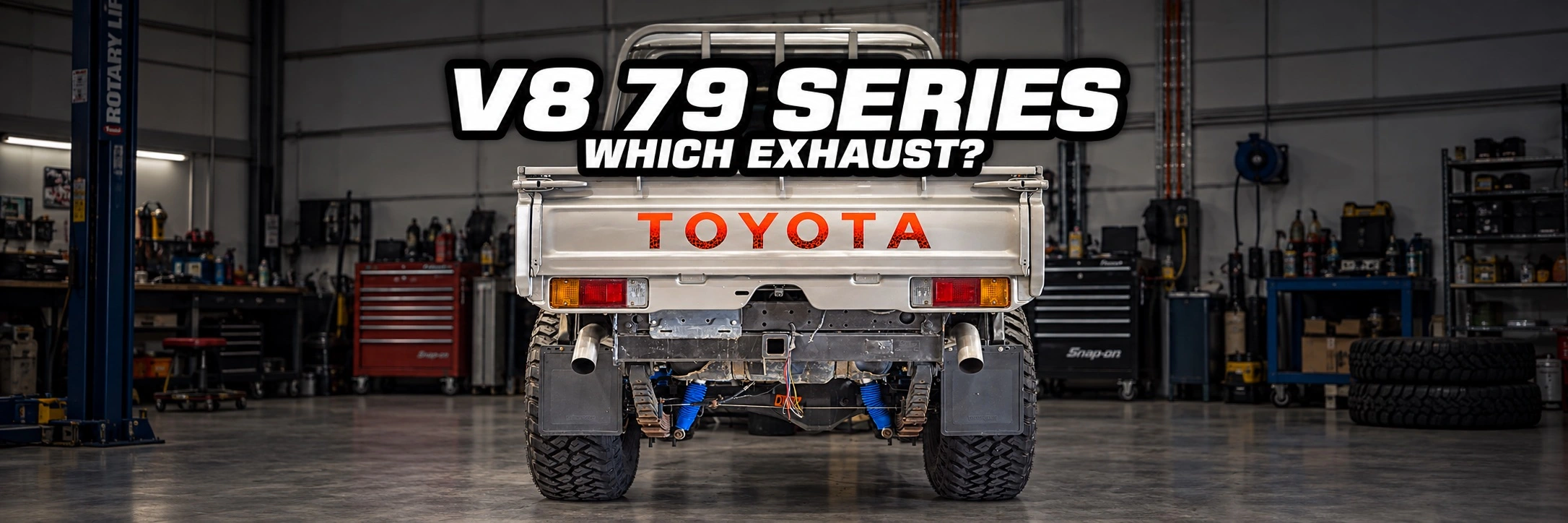
If you’ve gone looking for an exhaust for your V8 LandCruiser 70 Series, you’ve probably hit the wall already.
3-inch or 4-inch.
Aluminised or stainless.
Single or twin.
DPF back or turbo back.
Quiet, medium or loud.
Manta alone makes dozens of combinations for the 1VD-FTV.
Open any forum thread and someone’s swearing by a different one.
Only a few decisions actually matter. Make them in order and you’ll land on the right system.
Which exhaust do most V8 79 Series owners buy?
On a DPF model (late 2016 on), the system we sell the most of is a turbo back exhaust, in medium. 3-inch if you want the job done, 4-inch if you want the job done and the look and sound that go with it.
On a pre-DPF model (2007 to 2016), it’s even simpler: a 3-inch turbo back system in medium.
If you want to keep the DPF and skip the tune, a 4-inch DPF back system is the bare minimum. It sounds better than factory, but it won’t change much else.
Step 1: Do you have a DPF?
Whether you have a DPF decides which systems will even fit.
- Pre-DPF: VDJ76, VDJ78 and VDJ79 built from 2007 until late 2016.
- DPF model: built from around October 2016 onward. Toyota added a diesel particulate filter to the 1VD-FTV to meet newer emissions rules. Which sucks, I know.
If you’re not sure, check the build plate rather than the rego papers, or look under the car. The DPF is a large canister in the exhaust just behind the turbo. You can’t miss it.
Pre-DPF owners, skip ahead to the pre-DPF section. The rest of this is for DPF models.
Step 2: DPF back or turbo back?
A DPF back exhaust replaces everything behind the DPF.
The DPF and everything in front of it stay put. It’s the diesel version of a cat-back system on a petrol car. It bolts straight on and doesn’t need a tune.
A turbo back exhaust replaces everything from the turbo back, including the DPF. A straight dump pipe takes the DPF’s place. The engine then needs an ECU tune. Most tuning shops set the existing EGT sensors that talk to the ECU about the DPF’s condition to 600c (or more) so that it thinks it’s too hot to do a regen, so never does one!
Why most people go turbo back
The DPF is the biggest restriction in the factory exhaust. With it still in place, a bigger pipe behind it gains you very little. You’ll get a better sound and not much else. It also soaks up a lot of the noise. Even a big 4-inch DPF back system sits on the quiet side.
Our 4-inch aluminised DPF back system is $1,659. The 3-inch aluminised turbo back system that removes the DPF starts at $1,670. The pipe costs roughly the same either way. The real extra cost on the turbo back route is the tune.
Most customers who start out asking about a DPF back system end up doing the full turbo back system and a tune in one hit. It makes sense to do it once.
The legal bit
Removing the DPF from a registered vehicle driven on public roads isn’t legal in Australia. DPF delete systems are sold for off-road and competition use only. If your vehicle has to stay compliant, like a work vehicle or one under finance or lease conditions, go the DPF back system. It keeps the factory emissions equipment in place.
Step 3: 3-inch or 4-inch?
The factory exhaust on the DPF model is 2.25 inches. Either size is a big step up.
3-inch is the practical choice. It’s the cheaper of the two and suits a tuned engine on the factory turbo. If you just want the car to pull better and sound like a V8 should, 3-inch does the job.
4-inch flows more, sounds deeper and fills the rear of the car in a way a 3-inch doesn’t. Pick it if a turbo upgrade is on the cards, or if you just want the look. The 4-inch stainless turbo back is the most popular system Manta make for the V8 70 Series.
If you’re torn, ask yourself where the car will be in two years. Stock turbo and a tune? 3-inch. Planning a bigger build? Buy the 4-inch now and do it once. Read the gated turbo note in Step 6 first. A 4-inch with a gated turbo is a loud combination.
Step 4: Aluminised or stainless steel?
Aluminised steel is mild steel with an aluminium coating on it. It’s tough and it’s the cheaper option. Manta cover their aluminised systems with a two-year warranty.
Stainless steel costs more, lasts longer and still looks good years down the track. If you spend time on the beach, drive through salt water or live near the coast, stainless is money well spent. On the V8 the two sound almost the same.
For the 3-inch turbo back system, the difference is about $480 at the loud end. For the 4-inch, it’s closer to $800.
Step 5: Single or twin exit?
This one is almost entirely about looks and sound. A single exit exhaust does the job. A twin splits into two pipes at the rear for a louder, wider note and the classic V8 70 Series look.
For the DPF model, our Manta Twin 4-inch Exhaust System is the top of the range. It’s twin 4-inch stainless. It suits both the single cab and dual cab VDJ79. At about $5,840, if you want the car to be heard before it’s seen, this is the one.
Step 6: Quiet, medium or loud?
- Quiet has a full muffler and sits close to factory volume.
- Medium uses a smaller hotdog or resonator. It has a deeper V8 note with no drone on the highway.
- Loud has no muffler at all. It sounds great under load. You will hear it at 100km/h. Some people love that. Some people regret it on day three of a lap.
On our own 79 Series we chose medium. It’s what we recommend to nearly everyone. Towing or doing long highway stints? Definitely medium. A lot of people ask us for the best sounding exhaust for a 79 Series. For most owners that’s a medium system, not a loud one. You’ll still like it after eight hours in the seat.
The turbo changes the sound too
The turbo you run changes how loud the exhaust is. My own 2025 79 runs a 4-inch stainless turbo back system. With a VNT turbo on it, it was absolutely perfect. I’ve since fitted the UFI VDJ330 Gated Turbo. Gated turbos are louder than VNTs. Around town it sounds awesome, but on the highway it’s probably a bit much. And that’s the medium version.
If a gated turbo is in your plans, go one step quieter on the exhaust than you think you need. If you’re staying on a VNT, a 4-inch turbo back is hard to beat.
The VDJ79 DPF model range, single cab and dual cab
| System | Keeps the DPF? | Tune needed? | Material | Noise | From |
|---|---|---|---|---|---|
| 4-inch DPF back | Yes | No | Aluminised, black finish | Quiet side | $1,659 |
| 4-inch stainless DPF back | Yes | No | Stainless | Quiet side | $2,299 |
| 3-inch turbo back, DPF delete | No | Yes | Aluminised | Medium or loud | $1,670 |
| 3-inch stainless turbo back, DPF delete | No | Yes | Stainless | Medium or loud | $2,149 |
| 4-inch turbo back, DPF delete | No | Yes | Aluminised | Medium or loud | $2,729 |
| 4-inch stainless turbo back, DPF delete | No | Yes | Stainless | Medium or loud | $3,519 |
| Twin 4-inch, DPF delete | No | Yes | Stainless | Loud | $5,840 |
On the 4-inch DPF back systems, if your fuel tank has been lowered to fit an under-tray spare or a toolbox, the pipe can sit close to it. A gentle dent in the factory tank heat shield clears it.
Bare minimum vs sound and looks
| If you want… | Go for | What you get |
|---|---|---|
| A better sound, keep it compliant, no tune | 4-inch DPF back, aluminised | A nicer note and a factory-looking install. Little change in how it drives. The DPF is still the restriction. |
| The real improvement, on a budget | 3-inch turbo back, aluminised, medium, plus a tune | No DPF restriction, a tune to match, and the right sound without drone. This is the one we’d point most people to. |
| The same, built to last | 3-inch or 4-inch turbo back in stainless, medium, plus a tune | Same result. Shrugs off salt and still looks good in ten years. |
| Room to grow | 4-inch turbo back, medium, plus a tune | Deeper note now. Enough flow for a turbo upgrade later. |
| Look and sound first | Twin 4-inch, plus a tune | The full V8 70 Series statement. Loud, wide and hard to ignore. |
Going further than the exhaust
The exhaust and tune are usually the first step, not the last. Once the DPF is gone and the engine is breathing properly, the next restriction is the factory turbo. If you think you’ll end up there, buy the 4-inch now. A bigger turbo wants the extra flow. Our 1VD VDJ270 Performance Package is where most of those builds end up.
On a manual V8, more torque from a tune will find any weakness in a tired or standard clutch. The 1300NM Heavy Duty Clutch Kit is the one to look at before it starts slipping.
Pre-DPF V8 70 Series (2007 to 2016)
No DPF means no DPF back versus turbo back decision. A 3-inch turbo back system is the upgrade. Pick your body style, material and noise level and you’re done.
These systems replace the factory exhaust from the turbo back and are listed as off-road use only.
- VDJ79 single cab: the Manta 3-inch Exhaust System in medium or loud, or the Manta 3-inch Stainless Steel Exhaust System if the car sees salt.
- VDJ79 single cab, twin exit: the Manta 3-inch Twin Exhaust System, 3-inch from the turbo splitting into twin 3-inch tails that exit left and right. It won’t fit with ARB BP51 remote reservoir shocks.
- VDJ79 dual cab: the Manta 3-inch Exhaust System suitable for the VDJ79 dual cab, in medium or loud.
- VDJ78 Troop Carrier: the Manta Exhaust System suitable for the VDJ78, in quiet, medium or loud.
- VDJ76 wagon: the Manta Exhaust System suitable for the VDJ76 Wagon, in quiet, medium or loud.
If you plan to add a turbo upgrade or high flow injectors later, a 3-inch system is where to start. The factory exhaust will hold those upgrades back.
VDJ76 wagon and VDJ78 Troop Carrier, DPF models
The same DPF back versus turbo back choice applies to the wagon and the Troopy. There are just fewer options.
- VDJ78 Troop Carrier, October 2016 on: the Manta Exhaust System suitable for the VDJ78 DPF Model. Quiet is a DPF back system that keeps the DPF and needs no tune. Medium and loud are 3-inch turbo back systems that remove the DPF and need a tune.
- VDJ76 wagon, October 2016 on: the Manta Exhaust System suitable for the VDJ76 DPF Model. It comes as a quiet DPF back system, or a turbo back system with the DPF removed in quiet, medium or loud.
Frequently asked questions
Q: What’s the best exhaust for a 79 Series LandCruiser with a DPF?
A: For most owners, a 3-inch or 4-inch turbo back system in medium, with a tune. If the DPF has to stay, the 4-inch DPF back is the best compliant option. Expect a sound upgrade, not a performance one.
Q: When did the 79 Series get a DPF?
A: The V8 70 Series picked up a DPF from around October 2016. Anything built before that is a pre-DPF model.
Q: Does a DPF back exhaust need a tune?
A: No. It bolts on behind the factory DPF and the engine doesn’t know the difference. Any system that removes the DPF does need a tune.
Q: Will a 4-inch exhaust drone on the highway?
A: In medium, we don’t find it does. Loud systems with no muffler are a different story. You’ll hear them at highway speed. A gated turbo also makes any system louder than a VNT does. Allow for that if a turbo upgrade is coming. DPF back systems stay on the quiet side because the DPF absorbs a lot of the noise.
Q: Is there a sound difference between aluminised and stainless?
A: Only a slight one on the V8. Choose on how long you want the system to last and where you drive, not on sound.
Q: Is a DPF delete legal?
A: Not on a registered vehicle used on public roads. Systems that remove the DPF are sold for off-road and competition use only. If your vehicle needs to stay compliant, stick with a DPF back system.
Q: 3-inch or 4-inch for a V8 LandCruiser?
A: 3-inch if the car is staying on the factory turbo. 4-inch if you want the deeper sound, the look, or you’re planning a turbo upgrade later.
Still not sure which one suits your car? Give our Brisbane team a call. Tell us what the car does, what you’ve got planned and how loud is too loud. We’ll point you to the right system.
HD Automotive is not affiliated with, endorsed by or sponsored by Toyota Motor Corporation. Toyota, LandCruiser and all related model names are trademarks of Toyota Motor Corporation and are used here only to describe vehicle fitment.